
Word
variance
The state of being different or divergent, or a statistical measure of data spread.

Meanings
The quality or state of being different, divergent, or inconsistent; a discrepancy.
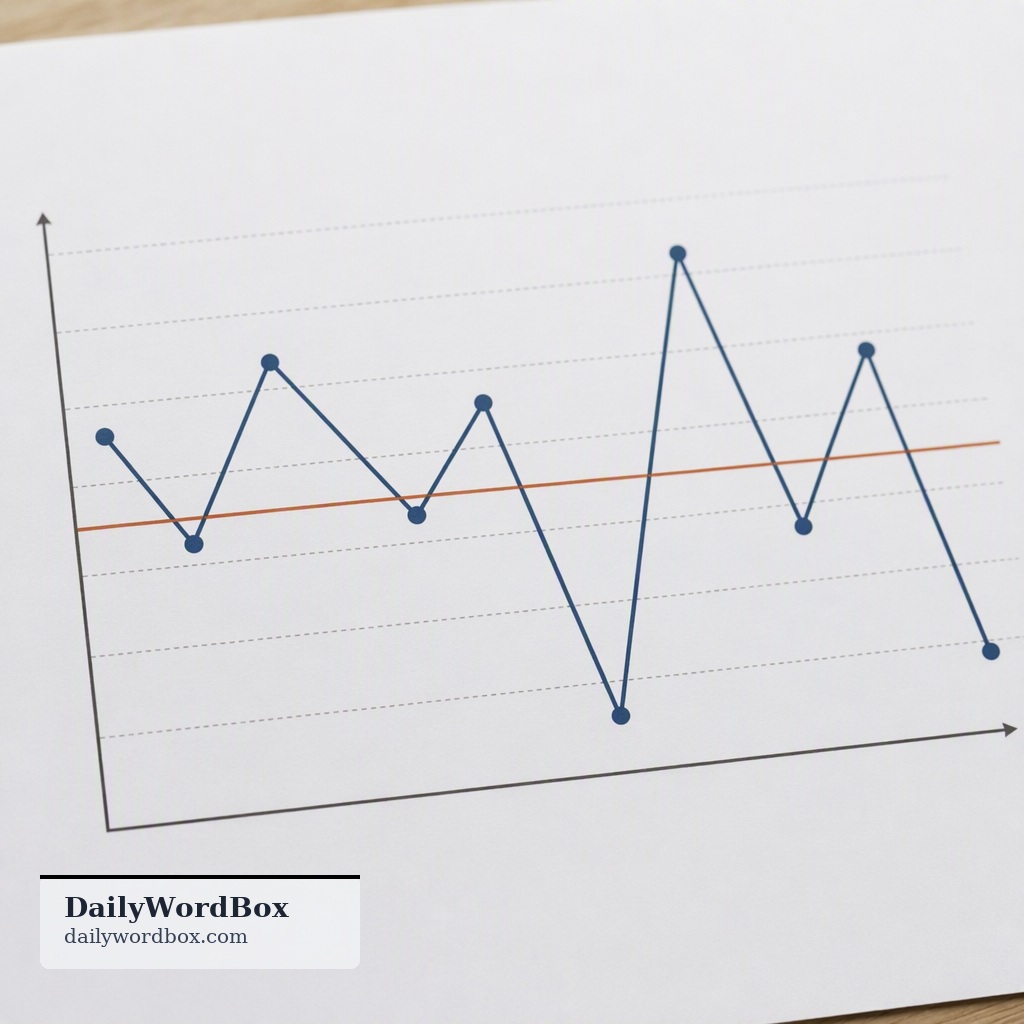
In statistics, a measure of the dispersion or spread of a set of data points around their mean, calculated as the average of the squared differences from the mean.
Definition
Variance refers to the quality of being different or inconsistent, often indicating a discrepancy between things that should be similar. In statistics, it's a specific measure that quantifies how much a set of numbers deviates from its average value. High variance means the data points are very spread out, while low variance means they are clustered closely together.
Examples
- The project team found a significant variance between the estimated costs and the actual expenses.
- Her opinion was often at variance with the general consensus, leading to lively discussions during the meeting.
- A high genetic variance within a species allows it to adapt more easily to changing environments.
- Statisticians use variance to understand how widely a set of test scores are distributed among students.
Common mistake
Learners sometimes confuse "variance" with "variation"; while related, "variance" often implies a specific measure of difference or a state of disagreement, whereas "variation" can refer to any change or slight difference.
More nouns
- deadline A deadline is a specific time or date by which something must be completed.
- fascism Fascism is an extreme right-wing political system with a powerful dictator, strong nationalism, and…
- gaslighting Gaslighting is a form of psychological manipulation that makes someone doubt their own memory, judg…
- narcissist A narcissist is someone who is excessively self-centered and craves admiration while showing little…
- empathy Empathy is the ability to understand and share another person’s feelings.